
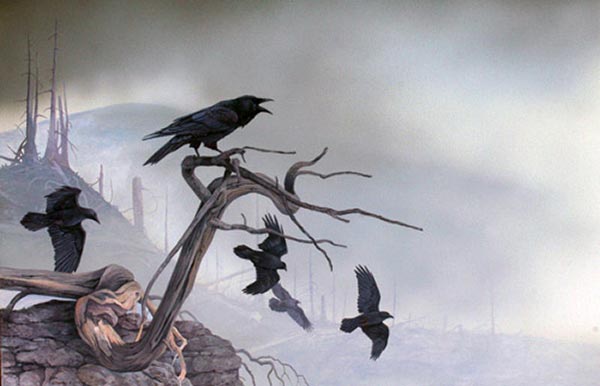
 End of Days, acrylic on board
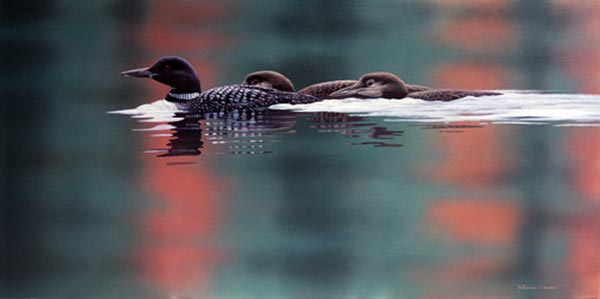 Lessons at Forked Lake, acrylic on board
It is perhaps inevitable that we classify art in terms of subject matter, as well as in terms of styles and historical periods. At times, though, such classifications obstruct rather than facilitate the progress of art or of art criticism. It is a commonplace to state that the eighteenth-century hierarchy which defined historical and religious subjects and then portraiture as the “highest” art forms was an impediment to the development of pure landscape in France and England. The same may be said today about the term “wildlife art.” As a mere descriptor of subject matter, the term is innocuous. When used to exclude this popular art form from the realm of “fine art,” the term is deleterious.
Ray Easton is a wildlife artist par excellence, which is to say that his subjects are birds, frequently in their native habitats. His work has appeared on numerous commemorative stamps, and he was selected as New York’s “Wildlife Artist of the Year” on four different occasions. As with any fine artist, though, the primary subject of Ray’s paintings is the complexity of the composition and the manner of presentation.
At times, Ray’s treatment of his avian subject becomes an exploration of abstract form. In “Crimson Camber,” for example, we can easily forget that the subject is a pair of flamingos, as we become enthralled with the colorful, overlapping “S” curves. In “Lessons at Forked Lake,” similarly, the compelling force of the piece is the aggressive horizontal thrust cutting across the field of amorphous color. It may not be too far-fetched to say that the effect is analogous to one of Barnett Newman’s “zip” paintings.
If some of Easton's paintings strive to pronounce an abstract form, other seek to evoke a powerful human emotion or to establish a visual metaphor for a human condition. As its title suggests, End of Days is a work charged with apocalyptic dread. Here the artist uses our traditional associations with the Raven to evoke a fearful sense of death and finality. Similarly, the shadowy, diaphanous background of Masquerade communicates the mystery normally associated with the owl. Both paintings explore our own symbolic associations with the animal depicted.
The success of Ray Easton's paintings lies not only in his refined compositional sense but in his technical range and virtuosity. When his artistic intention demands, he works with a hard edge and a very high degree of finish, to the extent that his paintings sometimes appear almost photographic. But he can also apply paint thickly and in strokes of bold virtuosity. In Spring Thaw, the stippled brushwork and the textured surface convey the roughness and irregularity of the ground in early spring. The artist is likewise capable of bold color contrasts, as in Crimson Camber, or of the most delicate gradations of tone, as in the painting Snow Blind. Underlying Ray Easton's art is the enthusiasm and respect of a devout bird-watcher. But his paintings never let us forget the artist who is watching them.
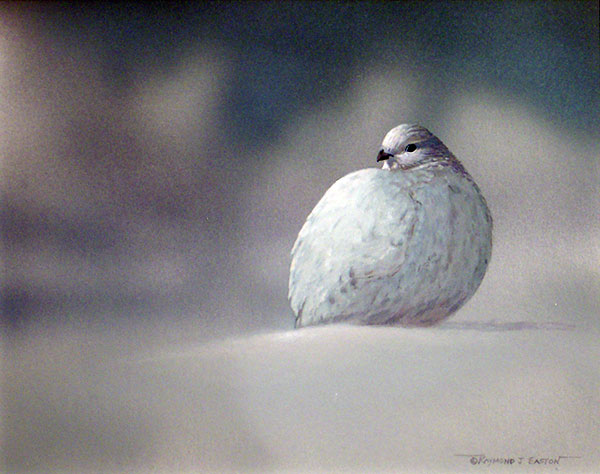 Snow Blind, acrylic on board
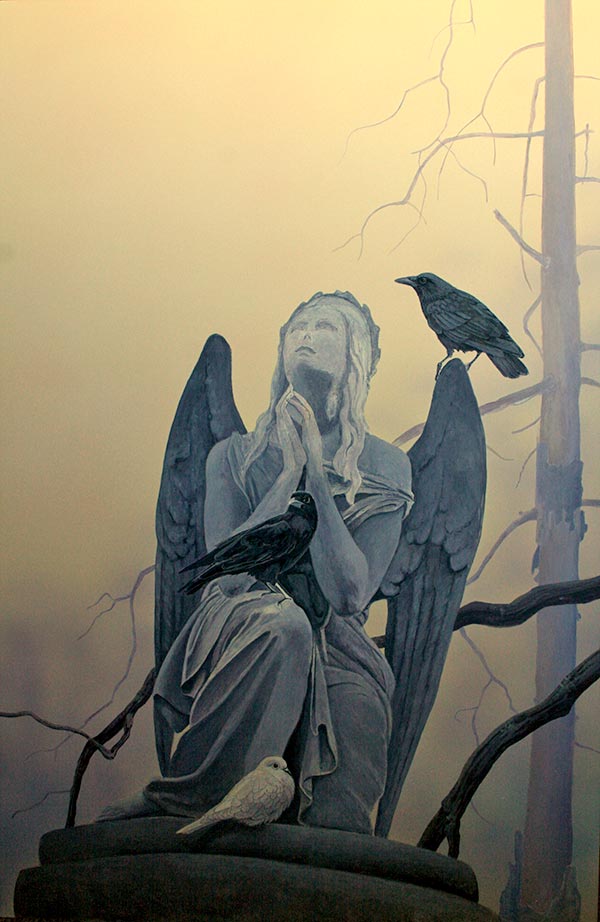 Birds of a Feather…, oil on canvas
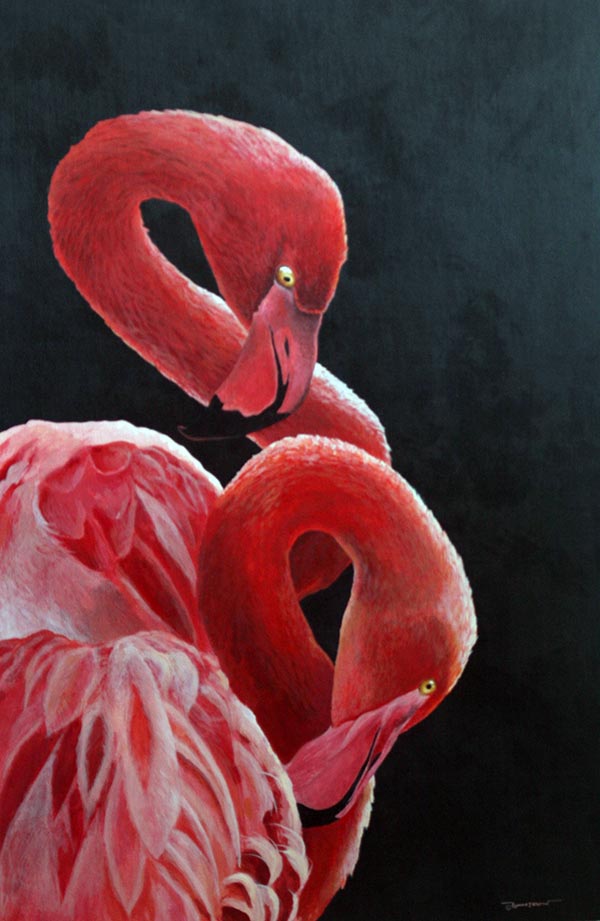 Crimson Camber., acrylic on canvasboard
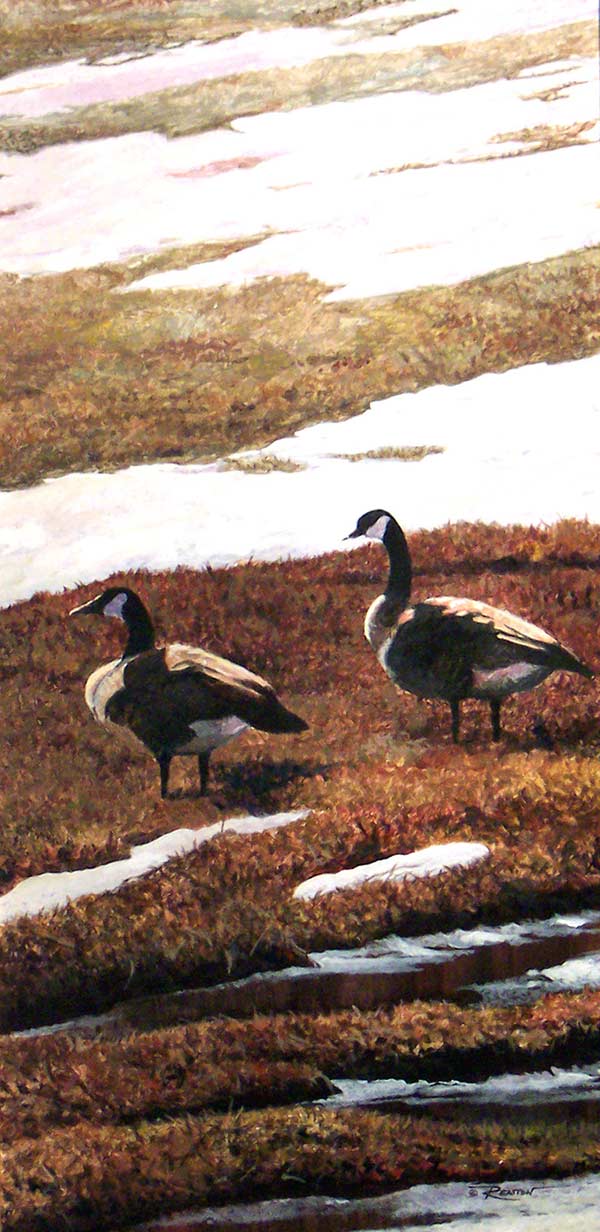 Spring Thaw, acrylic on board
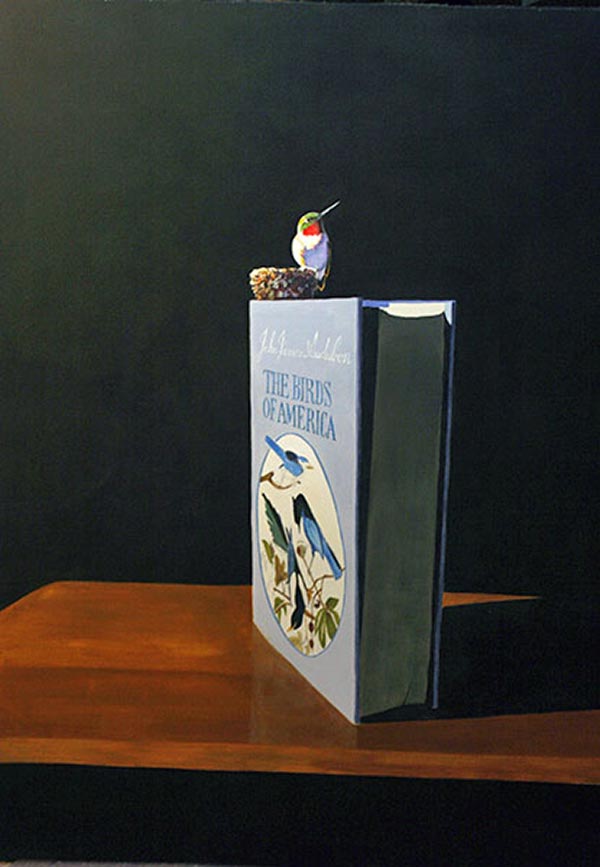 Last Light, acrylic on clayboard
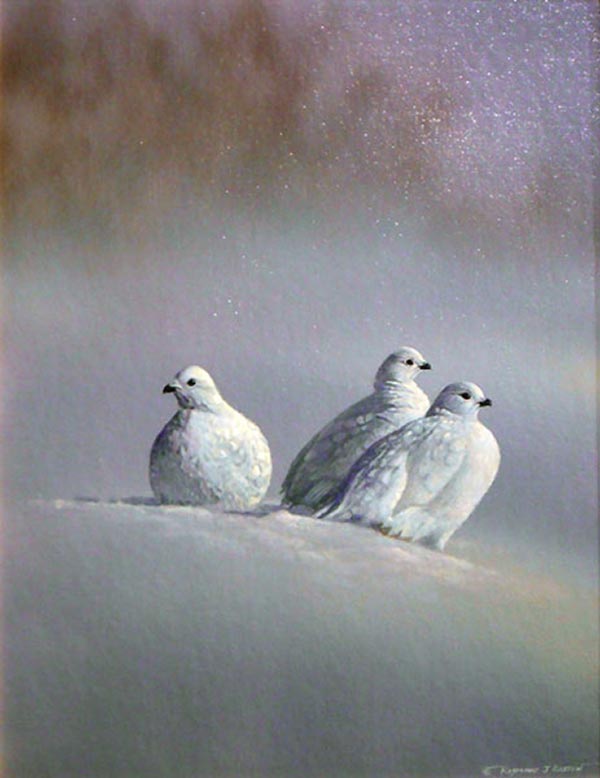 Shadows of Denali, acrylic on board
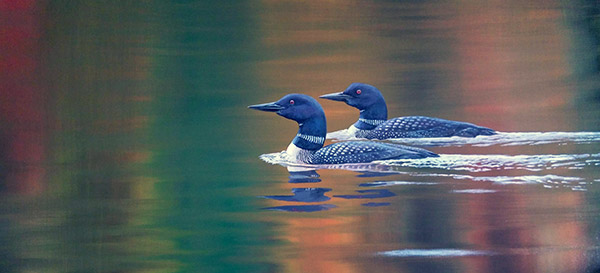 Adirondack Autumn, oil on board
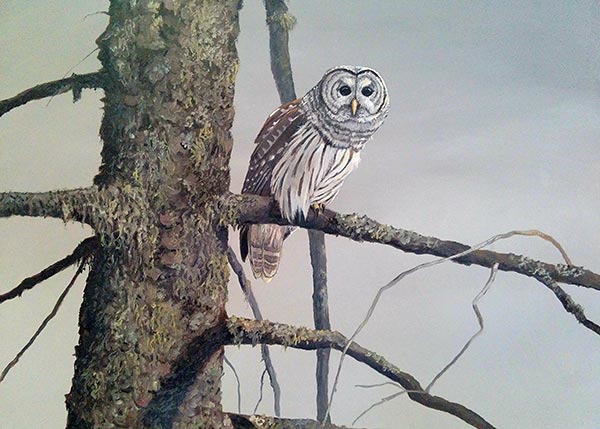 Hemlock Haunt, oil on board
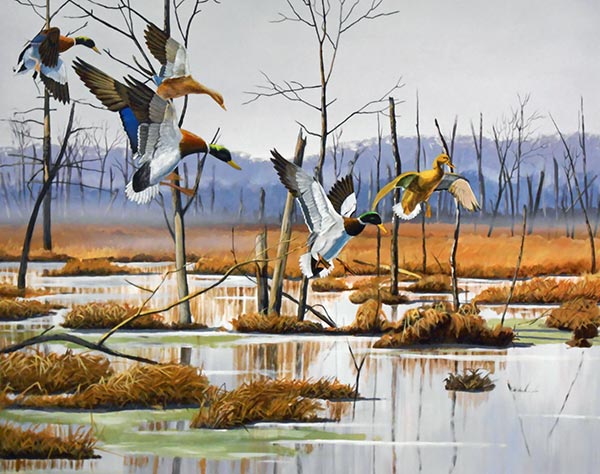 Marsh Manefestations, oil on board
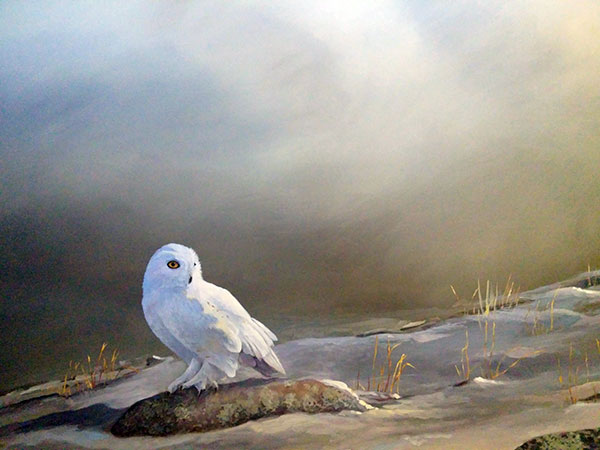 Tundra Twilight, oil on board
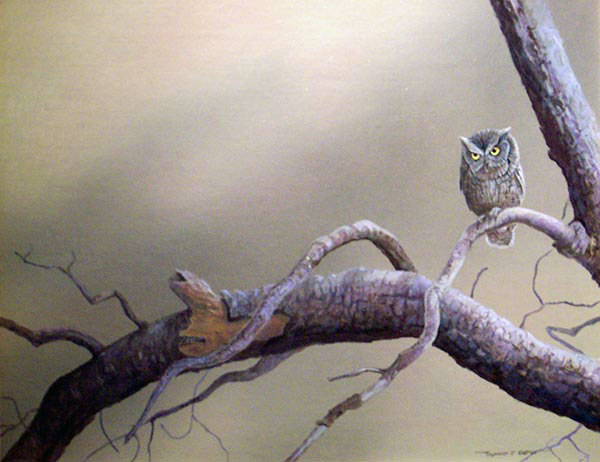 The Gloaming, acrylic on canvas
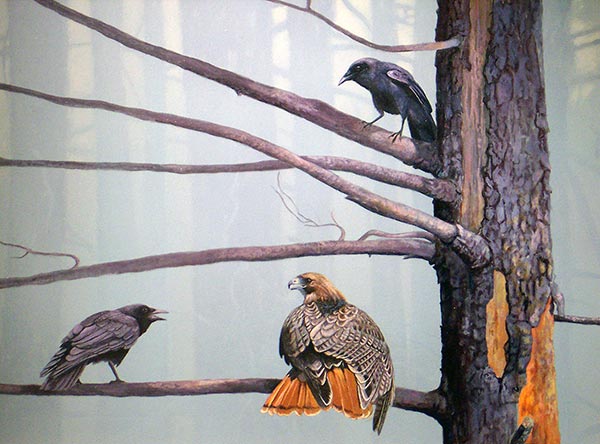 Shattered Silence, acrylic on clayboard
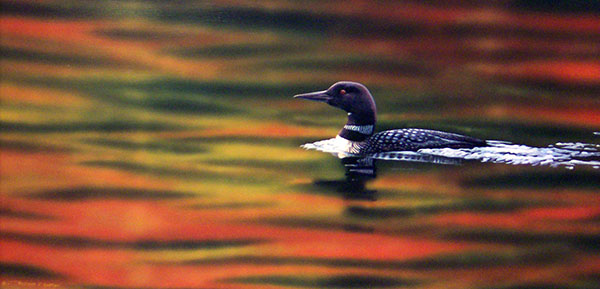 October Morning, acrylic on board
Prices available on request