
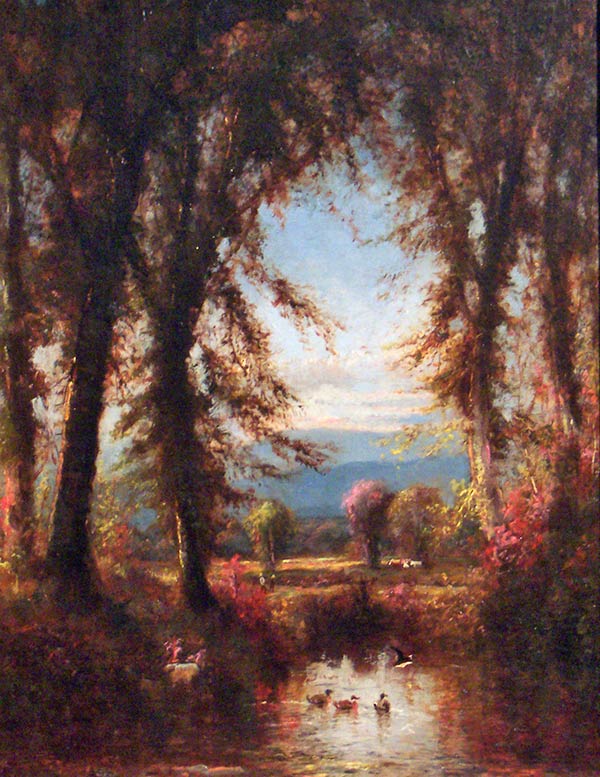
 A Forest Glade, oil on canvas, 17.75" x 13.75", 22" x 18" (framed), s.l.r. and dated 1875
Thomas Worthington Whittredge was born in May, 1820 near Springfield, Ohio, a town then on the edge of the western frontier. In his late teens, he moved to Cincinnati, where a thriving community of artists existed, under the patronage of men like Nicholas Longworth and with ties to the German academies in Düsseldorf and Munich. The artist experienced several business failures as a young man, first as a daguerrotypist in Indianapolis and then as a portrait painter in Charleston, West Virginia, and he returned to Cincinnati in 1844 to concentrate on landscape art. In 1849, Whittredge left Cincinnati for a stay in Europe of nearly a decade. In Düsseldorf, Whittredge was befriended by Emmanuel Leutze and made the acquaintance of fellow Americans Eastman Johnson, William Haseltine. Albert Bierstadt, and John Irving. In 1857, he settled for a time in Rome,.
Whittredge returned to the United States in 1859, renting a studio in the now famous Tenth Street Studio building. Here he found himself in frequent association with other luminaries of the Hudson River School: Gifford, Jervis McEntee, Frederick Church, David Johnson, and John Frederick Kensett. As his landscapes met increasing success, however, Whittredge gradually abandoned the darker style of the German academies and adopted the more pastel palette and light-filled canvases of the French Barbizon and Impressionist painters. He was elected an associate of the National Academy in 1860 and became a full Academician the following year, ultimately serving two terms as the Academy’s president in the mid-70’s.
Whittredge took many sketching trips throughout the northeast throughout his life. In the decades after the Civil War, however, he seemed to feel the need for new images and pristine wilderness and, like artists Gifford, Kensett, Bierstadt, and Thomas Moran, made a number of trips west. He also made two trips to Mexico in the company of Frederick Church. Whittredge died in Summit, New Jersy in February, 1910.
Works by Worthington Whittredge can be found in most major American museums, including the Cincinnati Art Museum, the Metropolitan Museum, the Museum of Fine Arts, Boston, The Chrysler Museum, the Brooklyn Museum, the National Gallery, the Corcoran Gallery, and the Smithsonian American Art Museum.
Prices available on request