
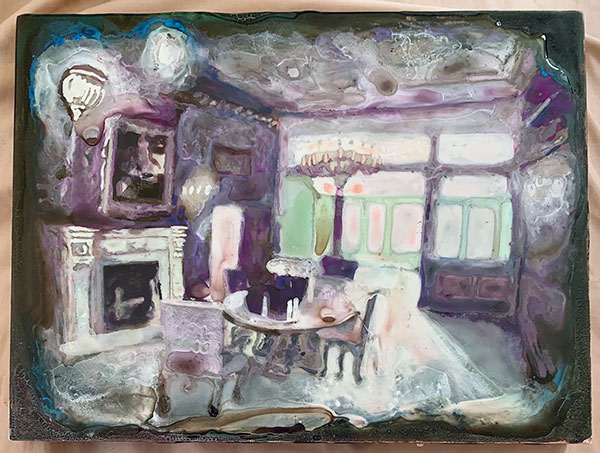
 Surrender to the Open Arms of Empty Air, gouache, ink, and resin on board
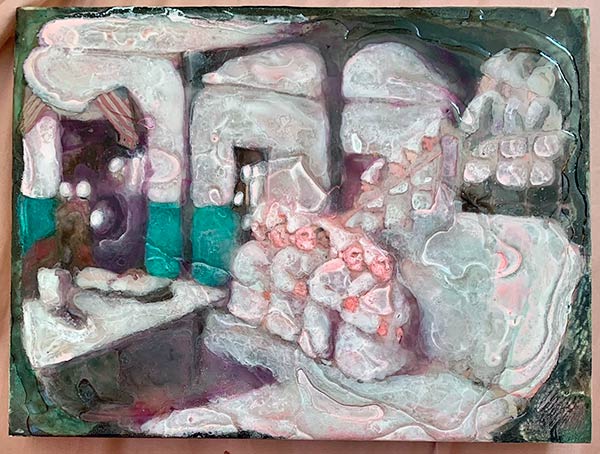 Procession, oil, gouache, and resin on board
About Matthew Klos & Ryan Schroeder
With the waning of Conceptualist ideologies, the last couple decades have found young artists returning with passion to the formal properties of their art. Two of the youngest artist in the ranks of the Oxford Gallery are Ryan Schroeder and Matt Klos. And the work of each artist appeals in large measure because of its youthful energy and its tireless searching after the right combination of formal attributes to express the subject. Both Ryan and Matt seem to embody the dictum of American philosopher and aesthetician John Dewey that “Sensitivity to a medium as a medium is the very heart of all artistic creation and esthetic perception.”
For these young artists, painting is finally all about paint. They choose their subjects from the near-at-hand because, in some measure, the choice of subject is incidental. Although their paintings often contain figures or have an implied narrative content, the true subject of each painting is the many decisions and discoveries the artist encountered in rendering the ostensible subject. Particularly when taken in aggregate, the work of each artist communicates a strong sense of experimentation. We are made aware of the way in which the shape, size and nature of the support affects our perception of the subject or of the manner in which the mass of a figure or form is defined by masses external or adjacent to it. We see the importance of the artist’s ground to overall tone and of tone to overall pictorial unity. We note the way in which our perception of a color is affected by colors adjacent to it and the way in which both color and form are influenced by the texture of the painted surface. And we sense, at more than a subconscious level, the artist focusing our gaze, while preserving the planar integrity of the scene, through articulation of some details and near abstraction of others.
These are, of course, issues which any painter confronts more or less consciously in painting a picture. What is important here is that in the work of Matt or Ryan, these issues take center stage, each painting communicating to us a sense of its own artifice. We do not take the formal properties for granted in looking at one of their paintings but perceive the formal properties as a series of decisions taken. The painting is a visual record of the trials and discoveries made during the creative process. Although it may seem an unlikely analogy, the painter that comes to mind here is Philip Pearlstein. Certainly the style of these young artists is nothing like that of Pearlstein, and it may be thought presumptuous to compare these painters with the established American master. Our point of comparison is simply that in Pearlstein’s work our perception of the subject is always subordinate to our sense of the difficulties the artist encountered in portraying it. We focus on the harsh lighting, the awkward poses of the fatigued models, and the constraints of the support at the cropped edges of the image.
In the paintings of Matt Klos and Ryan Schroeder, too, we are constantly aware of the artist. But it is not so much as the gestural presence of a third party. One might say, rather, that our point of view is always from behind the easel.
Artist's Statement
"My paintings are relics that document my existence. The last several years of my life have been spent living as a nomad in temporary housing, traveling city to city, and country to country. Every aspect of my life is transient, and I have had no choice but to adapt. Chaos rules all, and awareness of this fact forces me to immortalize the passing moments in paint. I often live in a room just long enough for one or two pieces. I record every arcane detail I am presented, because it will be gone within weeks. The same is true of models- nearly all of which are friends, lovers or family whose company can only be enjoyed momentarily. Some works are created with photographic references, which for me is the same concept as work from life- they are unique moments from my life experience, worthy of being observed and translated into paint because of the extreme hardships experienced while in the moments recorded in them. These works are palimpsests which reference moments of varying degrees of importance and interest to me personally as an artist."
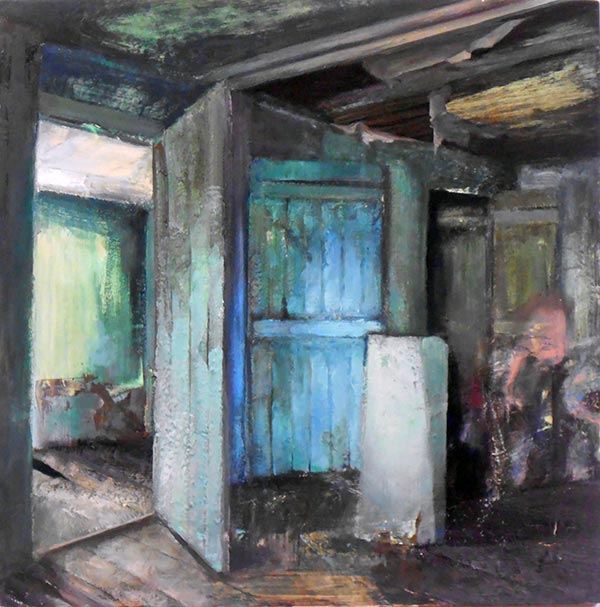 Specter, oil on clayboard
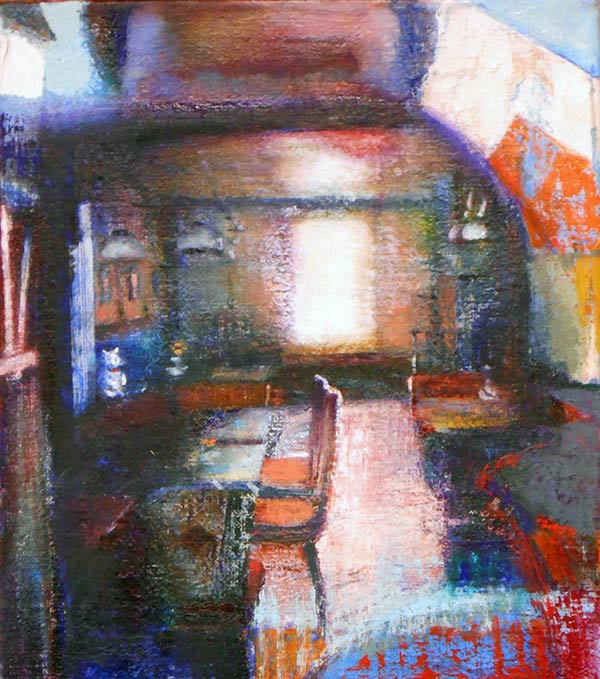 So Close, But Not Enough to See, oil on canvas
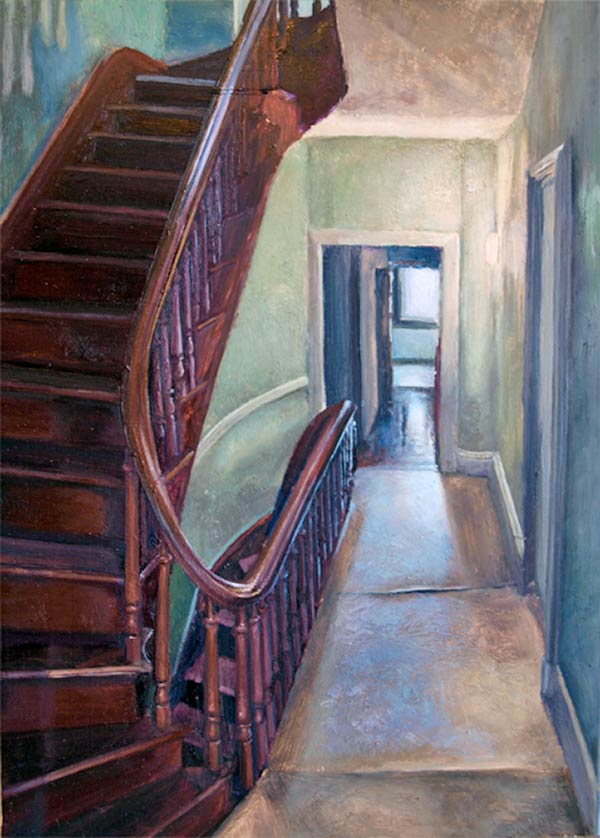 Artist’s Apartment, Mid-afternoon, oil on panel
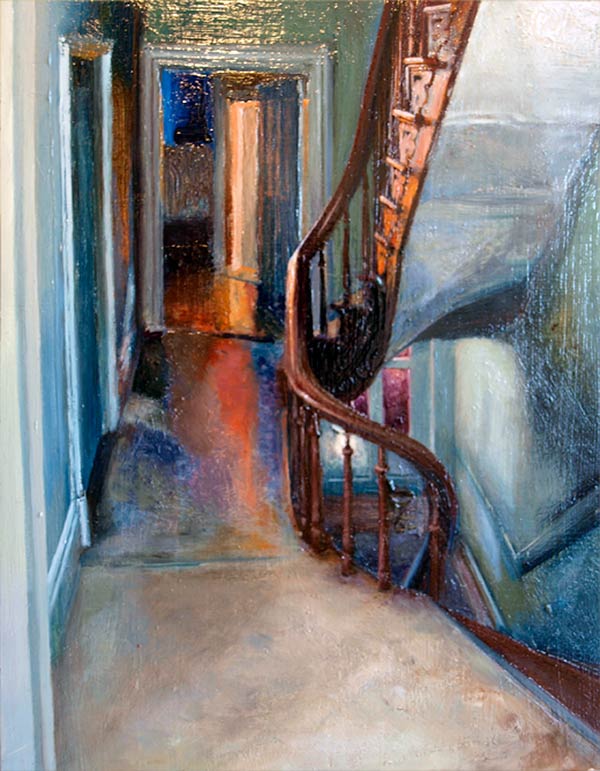 Artist’s Apartment, Evening, oil on panel
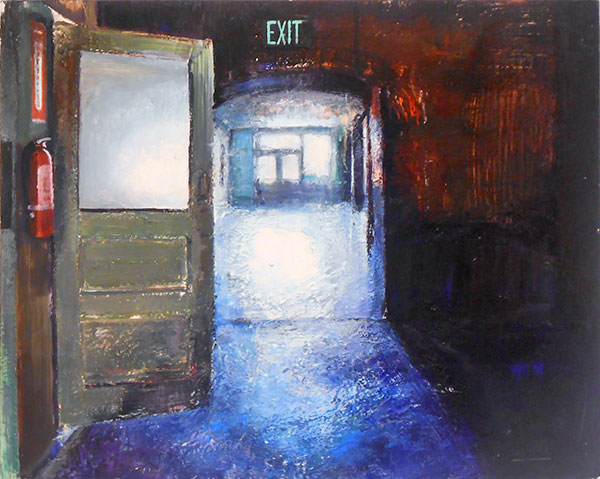 Industrial Void: Chromatic Progression, oil on clayboard
Prices available on request